CARDIAC › Programming basics › Programming with overlays
Beyond the basics: programming with overlays
CARDIAC has 100 cells, and a program shares them with its data. When the two don't fit together,
split the program into decks that take turns: each deck loads over the code before it, and the data stays where it
is. That is an overlay.
Why split a program
Memory is tight before a program starts. Cell 00 is wired to 001, cells 01 and 02 belong to the loader while a deck
goes in, and every JMP writes cell 99. What's left is shared by the instructions and the numbers they
work on, so every cell of code is a cell that can't hold data.
The sortem program in cardiac-code
shows how much that costs. It reads numbers, sorts them and prints them with their mean, minimum, maximum and
median. In one deck its code takes 94 cells, which leaves room for two numbers. Split into two decks, the same
machine sorts 35. Cardigan's examples do the same: 10-sort49 sorts up to 49 numbers in one deck, and
11-sort57 splits the work to sort up to 57.
How one deck hands over to the next
Nothing in CARDIAC clears memory. A deck ends with HRS, the operator puts the next deck in the reader
and starts the machine at 00, and the loader reads the new deck in over the old one. Each cell the new deck names
gets its new contents, and every other cell keeps what it held. That is the whole mechanism.
The convention is to halt with the PC on the next deck's number, so HRS 02 means "load deck 2". On a
paper CARDIAC, that number is a note to the operator. Cardigan reads it: when a program halts on n and deck n is
open, Cardigan puts that deck in the reader and runs the loader itself. That is one of the few conveniences
Cardigan adds to standard CARDIAC.
Across the handover:
- Survives: every cell the next deck doesn't load. That's where the data lives, and where one deck leaves
a message for the next.
- Replaced: the cells the next deck loads, and cells 01 and 02, where the loader builds itself again.
- Overwritten: cell 99, by the loader's
JMP 00.
Planning the memory
An overlay starts with a map of memory. Put the shared data where no later deck loads anything, and keep each
deck's code out of it. In sort57, deck 1 holds its code and variables in cells 03 to 41, and the numbers go in cells
42 to 98. Deck 2 is only cells 03 to 11, so it loads over the start of deck 1's code and leaves everything from
cell 12 up alone.
Cell 40 carries the message between them. Deck 1 calls it end and keeps in it where the next number
goes, as the instruction STO a+k. Deck 2 doesn't load cell 40, so the value is still there, and deck 2
reads it to know where to stop printing.
sort57 in Cardigan
Open 11-sort57 from the examples. Its 57 input cards are already in Input cards, and the
Decks pane, under Run and Debug, says which deck is in the reader.
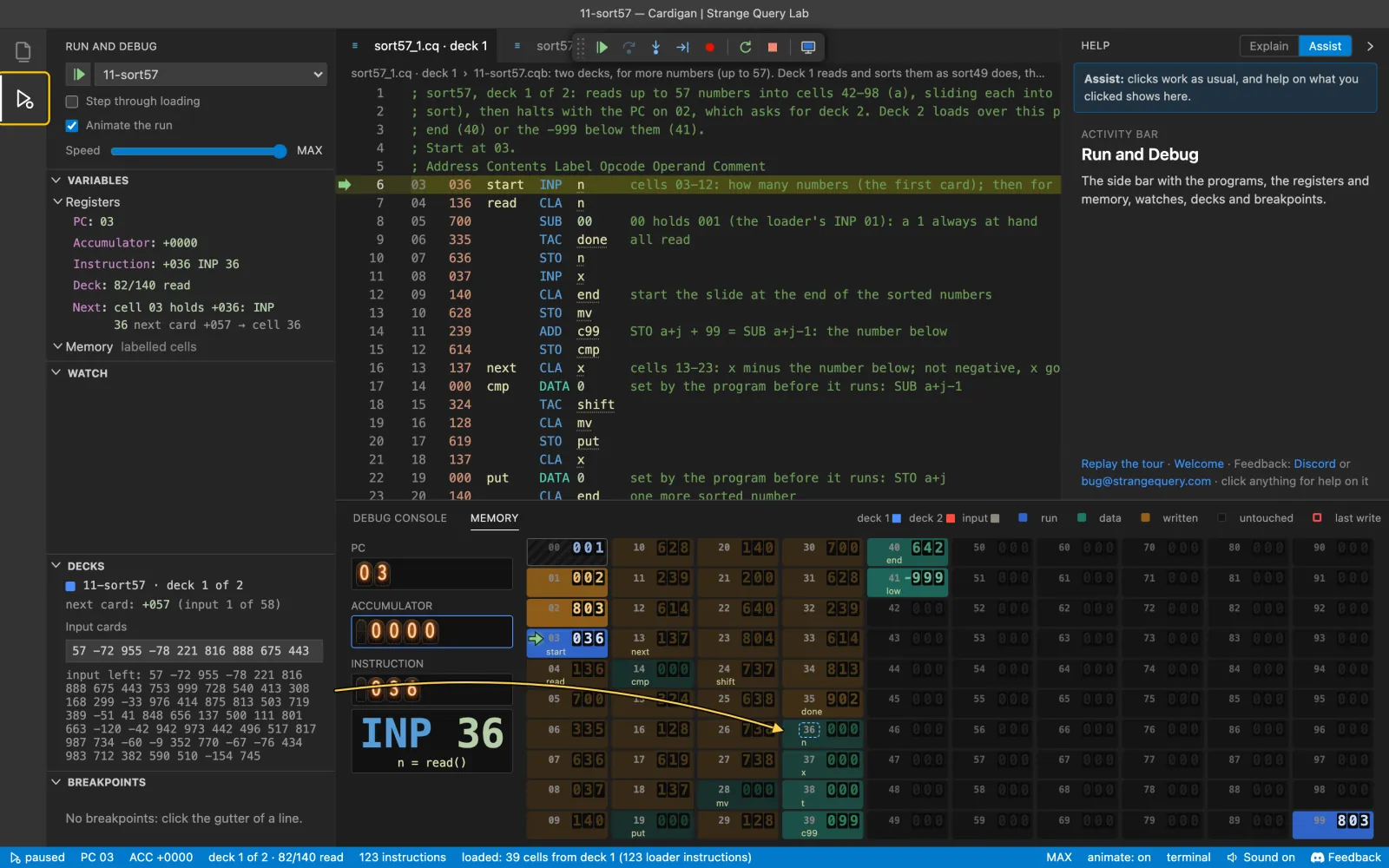 Deck 1 loaded: 39 cells in 123 loader instructions. Its cells are blue, and the PC is on 03, its first instruction.
Run it. Deck 1 reads the numbers one at a time and slides each into place among the ones before it. When the last
is in, it halts on 02. Cardigan puts deck 2 in the reader, the loader runs again, and the machine stops on deck 2's
first instruction.
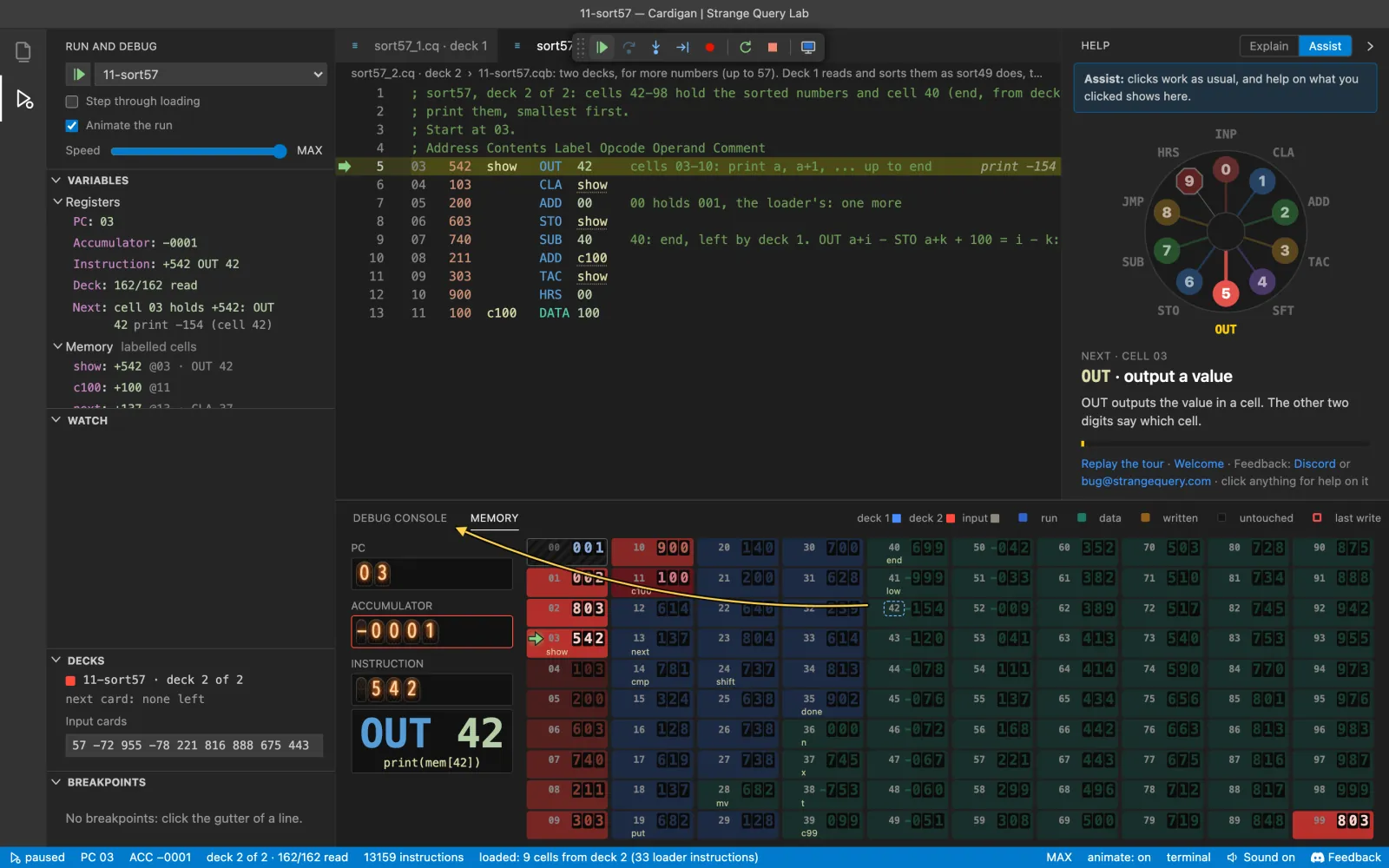 Deck 2 loaded over deck 1. Its 9 cells are red, with the loader's 01, 02 and 99. Deck 1's leftovers from cell 12 up stay blue and never run again. Cells 42 to 98 still hold the numbers, sorted, and cell 40 still holds
end.
Continue, and deck 2 prints the numbers, smallest first.
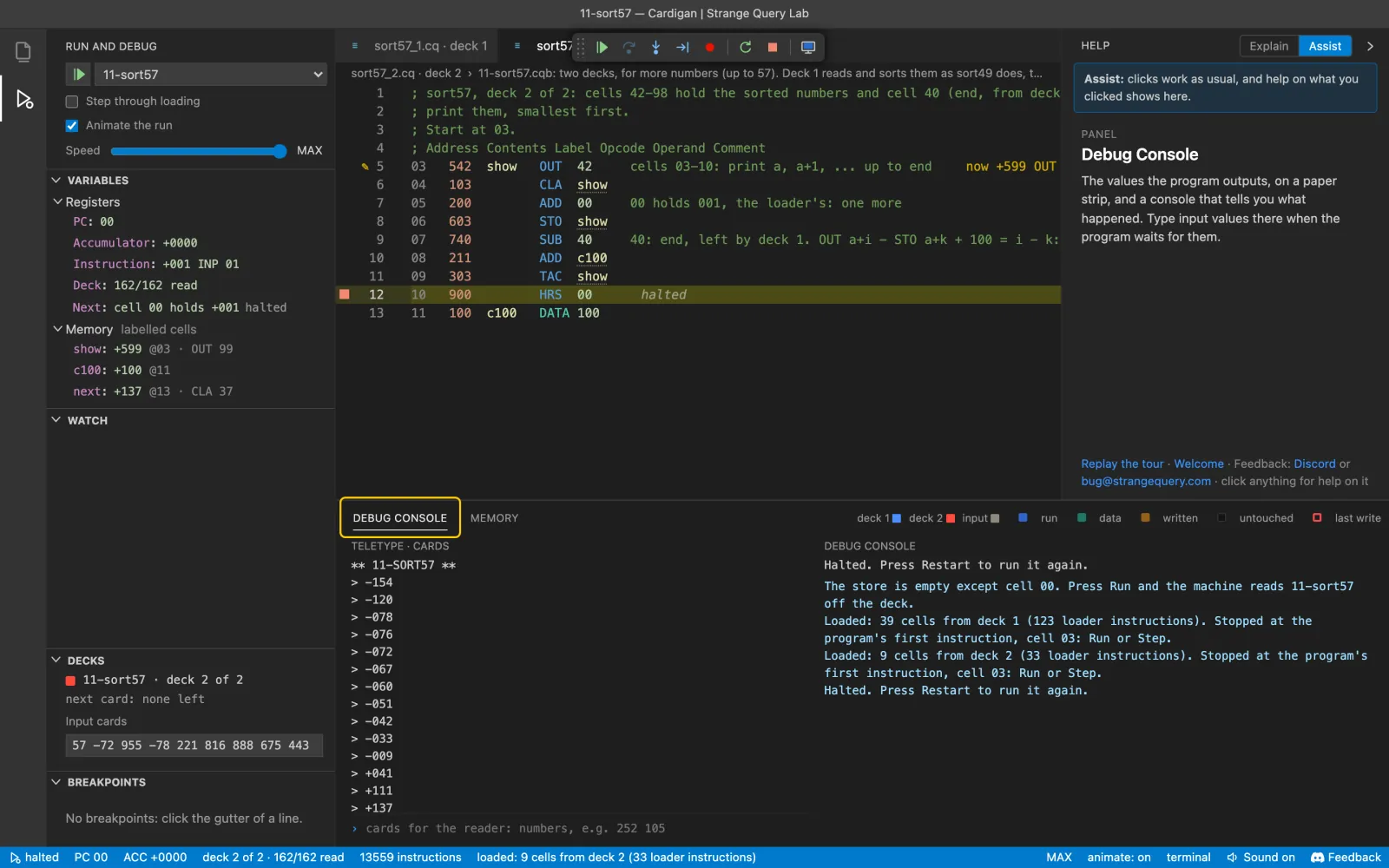 Done. The Debug Console tells the story: deck 1 loaded, deck 2 loaded, halted.
To watch each handover card by card, tick Step through loading before you run it.
Decks as files
A program in several decks is several files with one name: NAME.cqb for deck 1, then
NAME.2.cqb, NAME.3.cqb and so on. Open or drop them on Cardigan together, with a listing for each if you have one, NAME.cq or NAME_n.cq for deck n, to debug them by their source.
burn works the same way on the command line: when a program
halts on n, it reads NAME.n.cqb from the same folder and starts again at 00.
The tip when it doesn't fit, split it has the smallest
overlay there is: two tapes, one number passed between them.